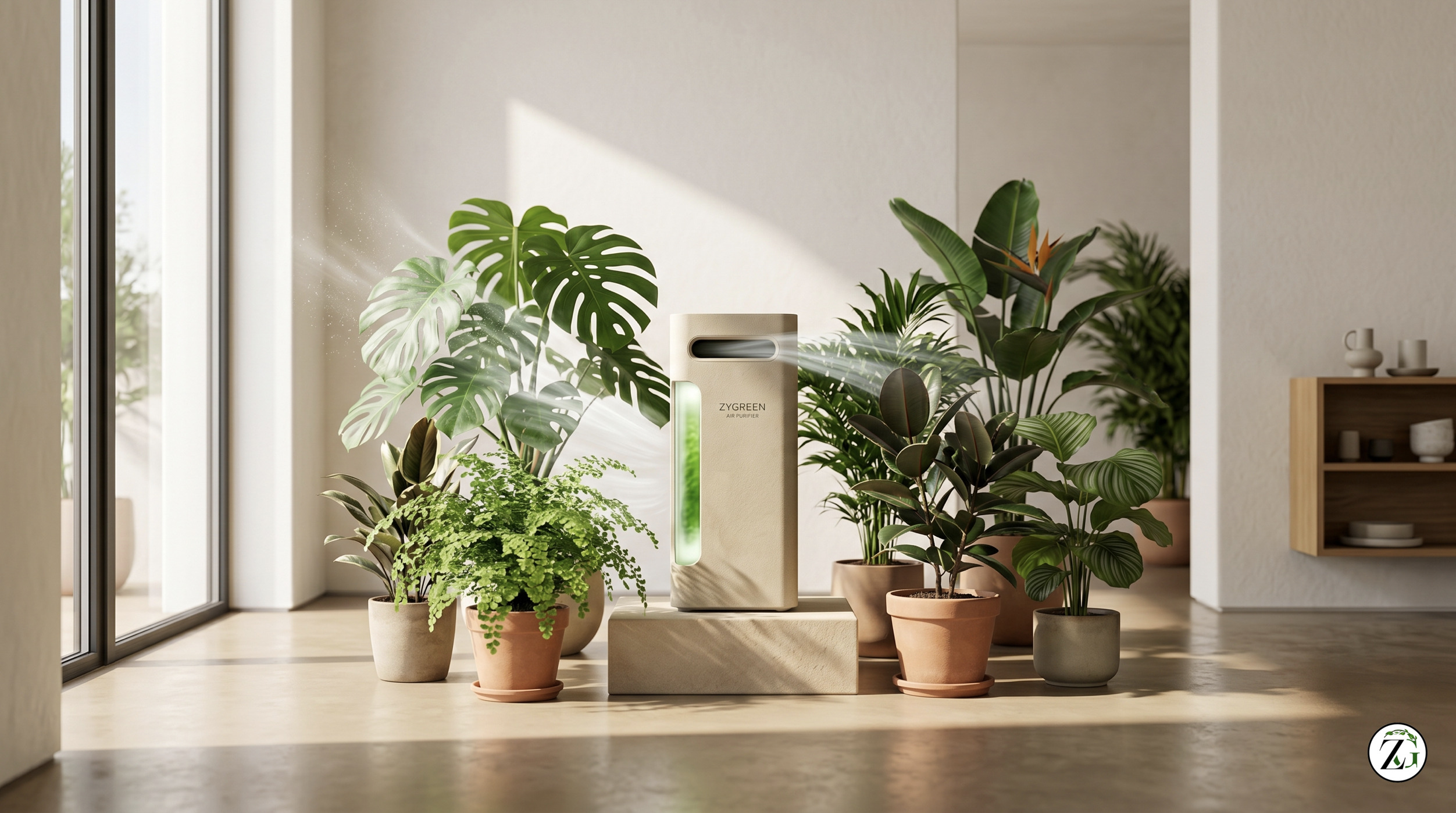
An algae air purifier grows living microalgae in a sealed, lit water chamber and passes room air across it. The algae take in carbon dioxide and release oxygen through photosynthesis — the same process that lets a forest breathe. It works on the one indoor pollutant ordinary air purifiers cannot touch: the CO₂ that builds up wherever people spend time together behind closed doors.
This guide explains how algae air purifiers work, where they do and do not replace a HEPA filter, and what to ask before you buy one for a home or office in India.
What is an algae air purifier?
Most air purifiers are filters: a fan pulls air through a mesh that traps dust, smoke and pollen. An algae air purifier is different. At its heart is a small photobioreactor — a chamber in which microscopic algae, commonly species such as Chlorella or Spirulina, are kept alive with water, nutrients and light.
Microalgae are among the most efficient photosynthesisers on Earth. They are single-celled and fast-growing, and they turn CO₂ into new growth much faster, for the space they occupy, than land plants do. That is why researchers have studied them for decades for carbon capture and water treatment.
An algae air purifier puts that biology inside a room. Some designs — including Zygreen's — are hybrids: a HEPA filter stage for particles and an algae stage for CO₂, in one unit.
How does an algae air purifier work?
- Air in. A quiet fan draws room air into the unit.
- Gas exchange. The air passes the algae culture — directly, or through a gas-permeable membrane that keeps the culture sealed — and CO₂ moves into the water, where the algae can use it.
- Photosynthesis. Using light, the algae turn CO₂ and water into sugars to grow, and release oxygen as a by-product.
- Air out. The air returns to the room carrying less CO₂ and more oxygen.
The chemistry is the textbook equation: 6CO₂ + 6H₂O + light → C₆H₁₂O₆ + 6O₂. For every molecule of carbon dioxide the algae take up, they give back about one molecule of oxygen.
Because the algae are alive and growing, every system needs some care — topping up water, adding nutrients, refreshing part of the culture. How often depends on the design: anything from every few weeks to every several months.
Why indoor CO₂ matters
Outdoor air today holds about 420 parts per million (ppm) of CO₂. Indoors, every person breathes out CO₂ all the time, so in a closed room the level keeps climbing. Bedrooms with the door shut overnight, meeting rooms, classrooms and air-conditioned offices regularly pass 1,000 ppm, and crowded ones go well beyond 2,000 ppm.
That is not only a comfort issue. In a 2012 study at Lawrence Berkeley National Laboratory, participants' decision-making performance dropped measurably at 1,000 ppm compared with 600 ppm, and sharply at 2,500 ppm. The symptoms of a stuffy room — drowsiness, headaches, poor concentration — are familiar to anyone who has sat through a long meeting.
The usual fix is ventilation: let in outdoor air to dilute the CO₂. In much of urban India that is a trade-off. Opening the windows lets in PM2.5, dust and traffic fumes; keeping them shut for the air conditioner or the air purifier lets CO₂ build up. An algae air purifier works on the CO₂ side of that trade-off without opening the room to the pollution outside.
Algae air purifier vs HEPA filter
The two are built to do different jobs — which is why hybrids combine them.
| HEPA air purifier | Algae-only purifier | Hybrid: HEPA + algae | |
|---|---|---|---|
| Main target | Particles: PM2.5, PM10, dust, pollen, smoke | Carbon dioxide | Both |
| Removes CO₂ | No | Yes | Yes |
| Adds oxygen | No | Yes, as a by-product of photosynthesis | Yes |
| Fine particles | Yes — a true HEPA filter captures at least 99.97% of particles at 0.3 microns | Depends on the design; ask the manufacturer | Yes, through the HEPA stage |
| Ongoing upkeep | Replacement filters | Care of the algae culture | Both |
| How it works | Mechanical filtration | Biological — living microalgae | Mechanical and biological, in one unit |
A HEPA filter is the proven answer to particle pollution, and on a bad-AQI day particles are the headline problem. But a HEPA filter does nothing about CO₂: a room can show a perfect PM2.5 reading and still feel stuffy. Activated-carbon filters help with odours and some gases, but they do not remove CO₂ in any meaningful amount.
So the useful question is not "algae or HEPA?" but "which problems does my space have?" If you are fighting smoke and dust, you need particle filtration. If people spend hours in a closed room, you also have a CO₂ problem — and that is the one algae solves. A hybrid handles both without a second machine in the room.
Do algae air purifiers actually work?
The biology is not in doubt: microalgae absorb CO₂ and release oxygen, reliably and measurably. The honest question is scale. How much CO₂ a unit removes depends on how much algae it holds, how much light the algae get, how much air passes them, and how many people are in the room adding CO₂. A small tabletop unit and a full conference room are not an even match.
Independent research on the approach is growing — for example, a 2026 study in Building and Environment tested an algae-based air purifier against CO₂, PM2.5 and TVOCs. When you compare products, look past comparisons with houseplants and ask for numbers:
- Measured CO₂ reduction in a real, occupied room — with the room size, the number of people and how long the test ran.
- Rated coverage in square metres, and how it was worked out.
- How it handles particles, if PM2.5 matters where you live.
- What maintenance involves, how often, and who does it.
- Noise and power use, especially for a bedroom.
A manufacturer that is confident in its product will answer all five.
Algae air purifiers in India
India makes a particularly strong case for this technology:
- Crowded, closed rooms. Offices, classrooms, coaching centres and meeting rooms often hold many people in a small space.
- Polluted outdoor air. Ventilating with outside air is often exactly what you are trying to avoid.
- Heat. In many cities, air-conditioned buildings keep their windows shut for most of the year.
The category is still young here. A small number of companies and research groups are building algae air purifiers, and most are sold directly or through early-access programmes rather than on store shelves.
Zygreen is one of them: a cleantech company from Kerala building hybrid algae air purifiers — multilayer HEPA filtration for particles and a living microalgal photobioreactor for CO₂ — for homes and institutions, supported by the GENESIS EIR grant from MeitY Startup Hub and AIC RAISE.
For homes: Zygreen Atelier
Zygreen Atelier is our hybrid algae air purifier for the home. Multilayer HEPA filtration captures dust, pollen and PM2.5, and a living microalgae culture absorbs CO₂ and releases oxygen.
- Coverage: up to 120 sq m
- Noise: under 18 dB
- Power: about 12 W on average
- Size: 30 × 30 × 90 cm, 12 kg
- Maintenance interval: about six months
For offices and commercial spaces: Zygreen Desk
Zygreen Desk is our modular hybrid system for offices, malls, hospitality and public spaces. Units are stackable and cover up to 500 sq m each, integrate with existing HVAC, report to a remote monitoring dashboard, and are looked after by our own maintenance team.
Frequently asked questions
Is an algae air purifier safe to use indoors?
In a well-designed unit the algae culture is fully enclosed and never comes into contact with the room. Species commonly used for air purification, such as Chlorella and Spirulina, are also grown as food supplements. In Zygreen modules the culture is sealed inside the unit.
Does an algae air purifier replace a HEPA purifier?
An algae-only unit does not: algae targets CO₂, HEPA targets PM2.5. A hybrid does both. Zygreen units pair multilayer HEPA filtration with the algae stage, so one unit handles particles and CO₂. Whatever you buy, check what it does about particles before you rely on it for smoke or dust.
Does it need sunlight?
Algae need light to photosynthesise. Some designs build the light in; others use the light already in the room. Ask how a unit performs at night and in darker rooms.
How often does the algae need looking after?
It depends on the design — some units need the culture refreshed every few weeks. Zygreen Atelier is serviced about every six months, and Zygreen Desk installations are maintained by our own team.
Can an algae air purifier replace ventilation?
No single device replaces fresh air entirely. What an algae air purifier does is take CO₂ out of the air already in the room, so you depend less on opening windows to the pollution outside.
Where can I buy an algae air purifier in India?
Zygreen is in early access, with limited units for 2026. Talk to us to join the waitlist or plan a deployment for your office or institution, or read more in our FAQ.