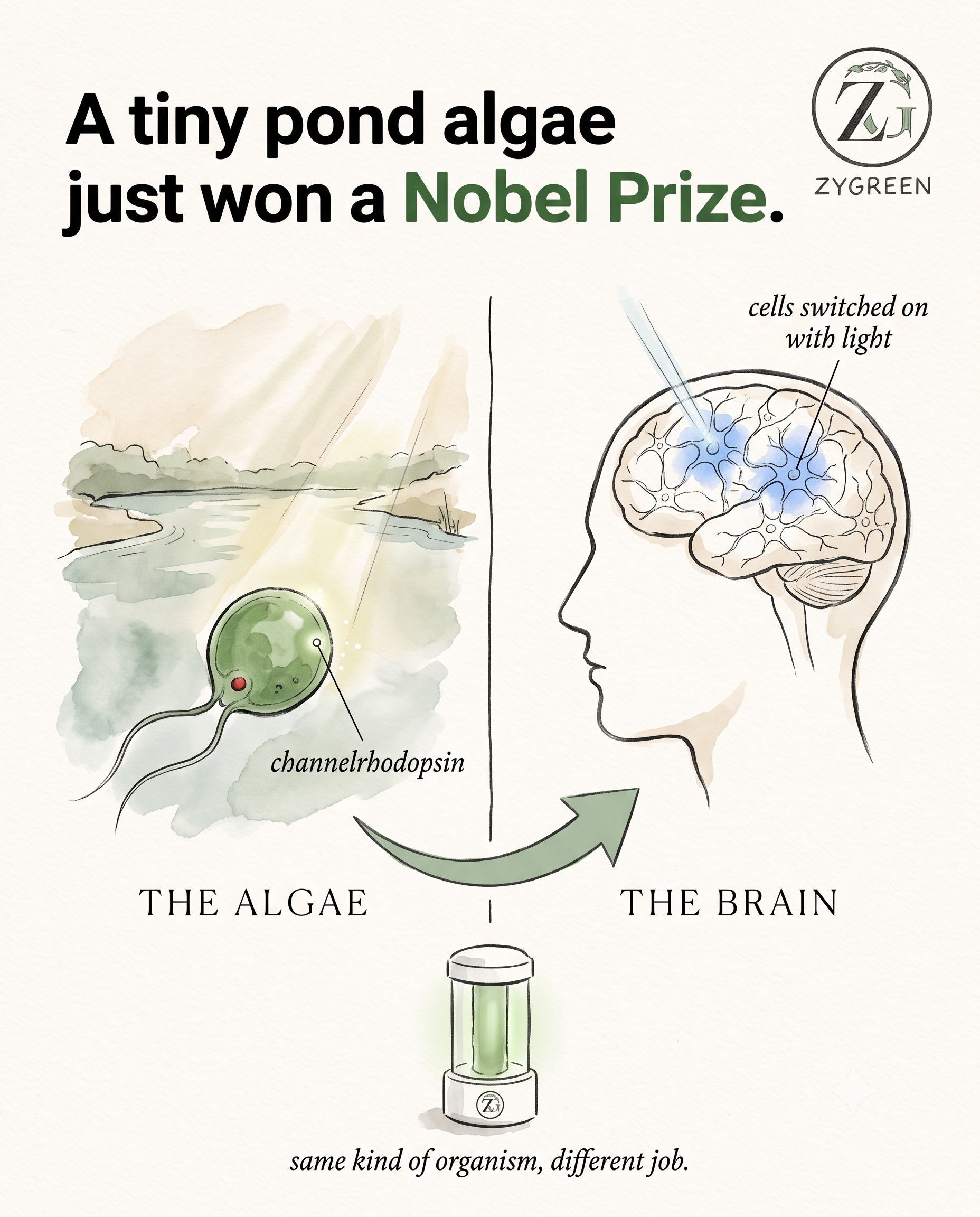
The 2026 Nobel Prize in Physiology or Medicine was awarded to Karl Deisseroth, Peter Hegemann and Georg Nagel for discoveries on light-gated ion channels and optogenetics. The work traces back to a protein called channelrhodopsin, found in a single-celled green microalga, Chlamydomonas reinhardtii, which uses it to swim toward light. Scientists later moved that protein into brain cells so they could switch them on and off with light.
Most people have never looked at a microalga. It is invisible without a microscope, it lives in ponds and puddles, and it does not look like it could change anything.
On 5 October 2026, that changed. The Nobel Committee announced that the year's prize in Physiology or Medicine would go to three scientists whose work began with a curiosity about how a microscopic green alga senses light.
I am a microbiologist, and my company, Zygreen, builds air purifiers around microalgae. So this announcement matters to me. This article explains what happened, how an alga ended up in neuroscience, and what the story tells us about this class of organisms.
What was the 2026 Nobel Prize in Physiology or Medicine awarded for?
The prize was awarded jointly to Karl Deisseroth, Peter Hegemann and Georg Nagel for their discoveries concerning light-gated ion channels and optogenetics, according to the Nobel Prize announcement.
In plain terms, optogenetics is a method that lets researchers switch the activity of individual nerve cells on or off in a living brain, using light. It has become a standard tool for studying how the brain forms memories, feelings and behaviours, and for studying the neurons involved in psychiatric and neurological disorders.
The Nobel Prize's own popular summary is titled "A light-sensitive algal protein energised neuroscience." The algae are not a side note. They are in the headline.
What are microalgae?
Microalgae are microscopic, mostly single-celled organisms that make their own food by photosynthesis. They live in fresh water, seawater and damp soil. Like plants, they take in carbon dioxide (CO2) and release oxygen. Unlike plants, they have no roots, stems or leaves, and every cell is in direct contact with its surroundings.
Two clarifications help avoid common confusion:
Not all "algae" are the same kind of organism. Chlamydomonas reinhardtii, the alga behind the Nobel Prize, is a true green alga. Spirulina, which many people also call an alga, is technically a cyanobacterium (a photosynthetic bacterium). Both are often grouped as microalgae in everyday use. Microalgae are very old. Photosynthetic microorganisms have been changing Earth's air for billions of years, and ocean phytoplankton are commonly estimated to produce about half of the oxygen we breathe. Meet Chlamydomonas reinhardtii, the alga behind the prize
Chlamydomonas reinhardtii is a single-celled freshwater alga. Under a microscope it looks like a tiny green sphere with two whip-like flagella that it uses to swim. It also has a small light-sensing patch, often called an eyespot.
Biologists have studied it for decades because it is easy to grow and it responds to light in a clear way: it swims toward light of the right strength, a behaviour called phototaxis. The question that drove Peter Hegemann's work was simple. How does a cell with no eyes and no brain know where the light is?
From a swimming alga to optogenetics: a timeline 1985: Peter Hegemann begins studying how algae perceive light at the Max Planck Institute of Biochemistry in Martinsried. 2001: Hegemann's group finds new gene sequences in Chlamydomonas that encode large microbial rhodopsins. 2002: The team identifies and names channelrhodopsin-1. 2003: Channelrhodopsin-2 is described and shown to work when placed in mammalian cells, using light to change the electrical state of the cell. 2005: Karl Deisseroth's lab, working with Georg Nagel and collaborators, shows that channelrhodopsin-2 can make cultured neurons fire when exposed to light. 2026: The Nobel Prize in Physiology or Medicine is awarded for the discoveries concerning light-gated ion channels and optogenetics.
The key finding was that in the alga, one protein does two jobs. It senses light and forms the channel that lets charged particles (ions) pass through the cell membrane. Most proteins split those tasks. This one does both, which is exactly what makes it useful as a switch.
How does optogenetics work? Step 1, find a light-sensitive protein. Channelrhodopsin from Chlamydomonas opens a channel when hit by blue light. Step 2, deliver its gene to the target cells. Researchers place the gene into specific neurons, often using a harmless virus as the carrier. Step 3, shine light on the brain region. Often through a thin optical fibre. Step 4, watch what happens. The cells that carry the protein switch on while the light is on, and researchers record what the animal does or what the circuit does.
Because only cells carrying the gene respond, scientists can test what a very specific group of neurons does, something older methods could not do with the same precision.
Why this matters beyond neuroscience
The most useful lesson of this prize is not about the brain. It is about curiosity.
Nobody in the 1980s and 1990s was trying to build a tool for brain science. A researcher wanted to understand how a pond alga finds light. The answer turned out to be a protein that, years later, neuroscientists could borrow. As the researchers themselves have said, few could have expected that the solution to a hard problem in the brain would come from algae.
For people who work with microalgae, that is a reminder of how many biological solutions in these organisms we have not yet looked at.
What else do microalgae do?
Beyond the laboratory, microalgae are already part of daily life and active research:
Oxygen. Marine phytoplankton, which includes microalgae, are commonly estimated to produce around half of the oxygen in the atmosphere. Food and nutrition. Spirulina and chlorella are sold as food supplements around the world. Closed life support. Space agencies, including through the European Space Agency's MELiSSA project, have studied spirulina (Arthrospira) in closed-loop systems where air and food must be recycled. Air purification. Because microalgae take in CO2 and release oxygen, researchers and companies are exploring them for cleaning indoor air. This is the field Zygreen works in. Microalgae and indoor air: where Zygreen fits
Most of us spend the majority of our day indoors, often in sealed, air-conditioned rooms. In those rooms, people breathe out CO2 and the air is recirculated. Outdoors, CO2 sits at about 420 parts per million (ppm). In a closed office or classroom it can climb into the 1,000 to 2,000 ppm range through the day. Studies from groups including Harvard and SUNY Upstate have linked higher indoor CO2 with lower scores on decision-making tests.
A normal HEPA filter is excellent at catching fine particles, but it does not remove CO2. Plants on a shelf look good and lift mood, but studies suggest you would need an impractical number of them to match what ventilation does for air quality.
Zygreen's approach is to use a living culture of microalgae in a compact unit. The design is built around five mechanisms:
CO2: absorbed by photosynthesis and released as oxygen. PM2.5 and PM10: captured in the liquid medium and held in the biomass. Nitrogen oxides (NOx): dissolved in water and used by the algae as a nitrogen source. Volatile organic compounds (VOCs): absorbed into the culture and broken down by the algae and their associated microbes. Airborne microbes: inactivated by UV and physically captured in the liquid.
We pair the purifier with an air quality monitor that tracks CO2, PM1.0, PM2.5, PM4.0, PM10, temperature, humidity and AQI every few seconds. In our monitor, CO2 shows a warning at 1,000 ppm and a critical alert at 1,500 ppm, so teams can see their air instead of guessing.
What the Nobel Prize does and does not tell us
It is worth being clear here, because the link between a Nobel story and a product is easy to overstate.
What it shows: microalgae are far more than a green colour in a tank. They contain precise, powerful biological tools, and basic curiosity about them has already changed medicine and neuroscience.
What it does not show: the Nobel Prize does not validate any air purifier, including ours. Channelrhodopsin is not what cleans air, and the neuroscience of optogenetics has no connection to how our unit works. Zygreen has no link to the laureates or their work. We are simply working with the same broad class of organisms, for a different problem.
If you are evaluating any air purifier, ask for measured data from your own space, such as CO2 and particle readings over a working day, before and after.
Frequently asked questions
Who won the 2026 Nobel Prize in Physiology or Medicine?
Karl Deisseroth, Peter Hegemann and Georg Nagel, jointly, for discoveries concerning light-gated ion channels and optogenetics. It was announced on 5 October 2026.
Did algae win the Nobel Prize?
No. The prize went to three scientists. But their work is built on a light-sensitive protein, channelrhodopsin, from the single-celled alga Chlamydomonas reinhardtii.
What is optogenetics in simple words?
It is a method that uses light to switch specific, genetically targeted cells on or off. In neuroscience, it lets researchers test what a particular group of neurons does in a living animal.
What is channel rhodopsin?
A light-sensitive protein that also forms a channel in the cell membrane. In Chlamydomonas, it helps the alga detect light and swim toward it. In optogenetics, it is used as a light-operated switch for nerve cells.
Are microalgae used in air purifiers?
Yes, research and some companies are using microalgae cultures to take in CO2 and release oxygen indoors. Performance depends on the design, the species, the light and the room, so measured results matter more than claims.
Is spirulina a microalga?
In everyday language, yes. Scientifically, spirulina is a cyanobacterium, a photosynthetic bacterium, but it is grouped with microalgae in food, research and industry.
Key takeaways The 2026 Nobel Prize in Physiology or Medicine recognizes optogenetics, a method built on a light-sensitive protein from a single-celled microalga. The discovery began with curiosity about how an alga senses light, not with a plan to build a brain tool. Microalgae are already involved in oxygen production, nutrition, space life support research and indoor air work.